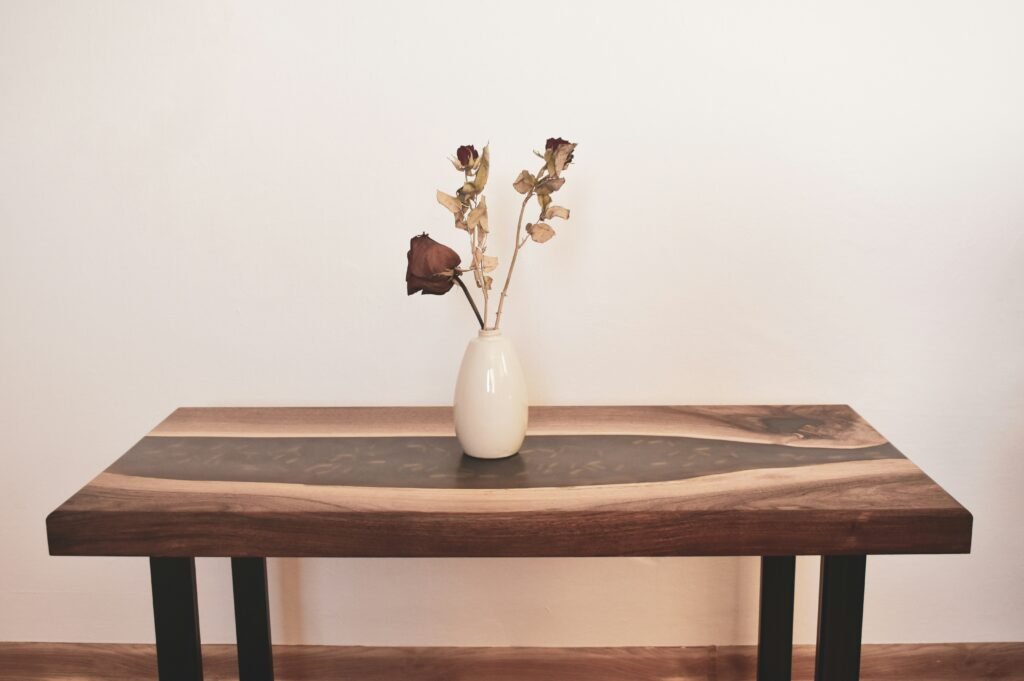
I still recall the sweet smell of walnut when I poured my first clear coat.
Warm resin spread over the slab.
Tiny bubbles danced.
A low torch hissed.
The grain woke under the new skin.
I felt like I had found treasure.
Then resin rolled over the edge and hit my boot.
I learned fast.
You will skip that stumble because this guide hands you every trick I picked up the hard way.
We will walk through each task in a clean order.
You will see what tools to grab.
You will know the right mix ratio.
You will learn how to tame bubbles, heat, and dust.
By the end you can give any board a hard glossy shield that makes color pop.
Let us dive right in.
Why epoxy loves wood
Epoxy comes in two liquid parts.
One holds resin.
One holds hardener.
When you stir both parts the cure starts.
The syrup turns solid and grips the fibers of the board.
That grip does three big jobs.
- It seals and locks the surface.
- It fills cracks, knots, and voids.
- It puts a clear coat that looks like glass.
Three common styles sit on store racks.
- Tabletop epoxy gives a thin self leveling layer about one eighth inch thick.
- Deep pour epoxy cures slow and can go three inches thick in one pass.
- Fast set patch epoxy mends small chips or cracks when time feels tight.
Pick the right bottle for each need.
Deep pour stays cool in thick pours.
Tabletop spreads quick for a smooth shell.
Pick dry friendly wood
Dry boards behave.
Wet ones fight the resin.
Shoot for wood at twelve percent moisture or less.
A pin meter costs little and saves big headaches.
Let boards rest in the shop for a week so the cells match your room air.
Good species for flood coats
- Walnut
- Cherry
- Maple
- Oak
- Ash
Tricky species
- Teak
- Ipe
- Pine loaded with pitch
Fix oily surfaces with a fast wipe of acetone then let it flash off.
Brush a thin coat of dewaxed shellac on teak or ipe before the resin.
Open grain oak loves to trap air so a seal coat stops bubbles.
Live edge slabs need extra care.
Knock loose bark away with a chisel.
A wire brush trims the sapwood and leaves firm wood ready for clear coat.
Set up a safe happy shop
Epoxy cures best at mild warmth and steady air.
Aim for seventy three degrees Fahrenheit.
Keep humidity under sixty percent.
Sand one day before you pour then clean up dust so none lands in wet resin.
Stretch clear plastic for a tent if the shop feels dusty.
Safety first.
- Nitrile gloves protect skin.
- Safety glasses guard your eyes.
- A respirator with organic vapor filters helps if the label says so.
- Soft airflow moves fumes away yet avoids strong wind on the piece.
Cover the floor with plastic over old cardboard.
Drips peel from plastic and the board holds shape on the flat pad.
Tools and supplies
A simple kit gets pro results.
Grab these items.
Mix gear
- Wide tubs with marks for volume
- Flat wooden stir sticks that scrape the sides
- A drill paddle if you mix big batches
- Silicone spreader
- Foam brushes
- A small propane torch or a heat gun
Prep and finish gear
- Random orbit sander
- Sandpaper from eighty grit up to four hundred for basic flood work
- Extra grits up to two thousand if you want a polished mirror finish
- Polishing compound and a soft buff pad
Control gear
- Strong sawhorses
- Shims and a bubble level
- Painter tape for the underside edge
- Packing tape for dams at voids
Clean up items
- Denatured alcohol for tools before cure
- Paper towels
- A trash bag ready by the bench
Budget swaps help when tools run short.
- No drill paddle. Stir longer by hand.
- No heat gun. Wave the torch with care.
- No silicone spreader. Use a clean playing card or a gloved palm.
Quick math for cost and coverage
One gallon coats about twelve and a half square feet at one eighth inch.
You can run a simple formula to check how much to buy.
Area times thickness equals volume.
Use inches for both length and width.
Use inches for thickness.
Divide the result by two hundred thirty one to get gallons.
Example
A top that measures forty eight inches by twenty four inches and needs one eighth inch thick coat uses this math.
Forty eight times twenty four equals one thousand one hundred fifty two.
Multiply that by zero point one two five.
You get one hundred forty four cubic inches.
Divide by two hundred thirty one.
You need zero point six two gallons.
Add twenty percent extra for loss and edge flow.
Tabletop epoxy runs about eighty dollars per gallon today.
Deep pour costs more.
Plan builds so you waste less.
Step by step guide
One level the work
Set the piece on stands.
Shim until a bubble level sits centered both ways.
Tape the underside edges with painter tape and leave a small lip.
Raise the board on small blocks so drips drop free.
Two sand clean and dry
If the board sits raw sand to one hundred twenty grit.
Stop there so resin bites.
Vacuum all dust.
Wipe with a damp microfiber.
Let the wood sit an hour so any damp leaves.
A clean surface stops fisheyes.
Three seal coat
Mix a small batch.
Three ounces of mixed resin per square foot cover open pores.
Pour part A and part B by the ratio on the jug.
Stir slow for four minutes.
Scrape the sides often.
Pour into a new tub then stir one more minute.
Brush a thin layer over the face and down the sides.
Pass the torch in a quick sweep to pop bubbles.
Wait until the seal coat feels tacky.
That sweet spot sits four to ten hours after mix.
Pour the flood coat during that window for a strong bond.
If time slips sand with two hundred twenty grit then wipe with alcohol and carry on.
Four mix the flood coat
Warm resin flows thin so set bottles in warm water for fifteen minutes.
Dry them well.
Use a wide tub so you stir without splashing air.
Mix slow and scrape the bottom.
Watch the swirl turn clear.
Let the bucket rest ten minutes.
Pass the torch across the surface of the mix to release trapped air.
Five pour and spread
Pour in a long smooth S curve.
Resin levels itself to one eighth inch.
Use the spreader to pull liquid to dry corners and edges.
Brush sides so each inch gleams.
Check the bottom edge for hanging drops.
Six bust bubbles
Hold the torch six inches above the surface.
Keep your hand moving.
Sweep across once.
Look at the glare line to spot bubbles.
Sweep again after one minute.
Stop after ten minutes so you avoid scorch marks.
Seven guard the cure
Place the dust tent.
Keep the room at steady warmth for two days.
Do not poke the surface.
Touch leaves prints.
Resin turns tack free in eight hours yet needs at least three days for full cure.
Remove painter tape while the coat feels rubbery.
Drips peel off clean.
Eight stack coats if you want depth
Pour a second flood coat when the first coat feels tacky.
If the cure passed that stage sand with two hundred twenty grit first.
Repeat bubble control and tent steps.
Fill cracks and knots
Flip the slab and tape the back of through holes with strong packing tape.
Brush a thin seal coat inside the void.
That step locks trapped air.
Use slow cure resin for deep pockets.
Pour in layers if the label warns about heat.
Torch bubbles after each layer.
Let fills cure rock hard before you plane or sand.
Deep pour river table basics
River tables look wild yet follow clear science.
Build a form with melamine.
Seal seams with clear caulk.
Coat the slick surface with packing tape so cured resin pops free.
Prepare slabs by cutting clean edges that face the river.
Remove soft bark.
Seal the slab edges with a thin resin brush coat.
Set slabs in the form with spacers.
Secure with hot glue blocks.
Leave room for resin to flow under and rise inside.
Mix deep pour resin.
Add powder pigment if you want color.
Pour slow right in the center.
Let the resin climb under then around the slabs.
Torch bubbles off and on for the first sixty minutes.
Watch the shop temperature because deep masses kick heat.
A small fan cools air if the slab feels warm.
Let the river cure three to five days.
Waiting two weeks before surfacing gives a hard panel that sands crisp.
Flatten with a router sled or drum sander.
Finish with a final flood coat or a hard wax oil.
Your call on the final shine.
Bubble prevention playbook
Bubbles come from three places.
Air in open pores, air whipped during mixing, heat inside thick resin pools.
Beat bubbles with this simple list.
- Warm the room to seventy three degrees Fahrenheit.
- Warm resin bottles in water for fifteen minutes.
- Seal coat raw wood.
- Stir slow.
- Let the mix rest before you pour.
- Pour close to the surface.
- Torch quick passes in the first ten minutes.
- Close doors and stop drafts.
If one spot keeps spitting bubbles check the bottom.
A hidden pin hole may let air rise.
Stick tape over it and brush fresh resin.
Sand and polish
A clean flood coat may only need light polish.
Wait full cure.
Shave proud drips with a sharp chisel.
Sand with three hundred twenty grit on a soft pad.
Move to six hundred, one thousand, fifteen hundred, then two thousand grit for a mirror.
Buff with polishing compound and a soft pad.
Keep the pad flat and move slow.
Wipe often.
If you crave matte stop at one thousand grit then rub wax after one week.
Care and upkeep
Epoxy stands strong yet likes gentle care.
- Wipe with mild soap and water.
- Skip harsh cleaners and scrub pads.
- Use coasters under hot mugs.
- Place a trivet under hot pans.
- Keep long bright sun off the surface to limit amber tint.
Small scratch fix takes three steps.
Sand with one thousand and fifteen hundred.
Buff with polish.
Deep gouge fix needs a sand down to level then a new flood coat.
Notes by species
Walnut shows deep color under clear resin.
Seal knots to block hidden air.
Maple glows bright.
Dark pigment rivers pop against pale grain.
Seal soft spots to prevent blotch.
Oak and ash have open pores and must get a seal coat.
Teak and ipe have oil that blocks bond.
Wipe with acetone, brush shellac, light scuff, then pour.
Pine has pitch that can rise.
Seal with dewaxed shellac first.
Spalted wood may crumble.
Brush thin epoxy to harden soft streaks before you pour.
Troubleshooting
Fisheyes look like craters.
They come from oil or silicone.
Fix by sanding clean, wiping with alcohol, and recoating.
Waves across the top show cool room or thin pour.
Let it cure, sand flat, and add a new coat warm.
Sticky spots stay soft when mix ratio was off.
Scrape them away, wipe with alcohol, sand, then pour fresh resin.
Clouds come from cold resin mixed too fast.
Warm the bottles, remix slow, then add a new coat.
Dust specks need sanding through two hundred twenty grit, then a fresh flood coat under a tent.
Edge curtains hang when you push too much resin over.
Shave cured runs, sand the edge, then brush a thin coat.
Lifting between layers shows missed bond window.
Sand dull, wipe, and pour again.
Yellow color creeps after long sun.
Keep projects out of harsh light or add an outdoor safe top coat with UV blockers.
Seasonal shop tweaks
Cold shop fix.
Warm the space one day before you pour.
Keep heat on for two days after.
Hot summer fix.
Work early in the day.
Store resin in a cool closet.
Mix smaller batches.
Use slow cure resin.
Humid day fix.
Run a dehumidifier.
Let wood reach room moisture before you pour.
Budget and time plans
Charcuterie board
- One hour prep
- One hour seal
- One hour flood
- One week cure
- Resin about one quart
Coffee table top
- Half day prep and seal
- One hour flood
- Two days watch
- One week cure
- Resin three quarts to one gallon
River coffee table
- Two days build and pour
- Ten days cure
- One day surface and finish
- Resin amount changes with river size so run the math
People often ask
- What is the best way to apply epoxy to wood
Clean and dry the board then brush a thin seal coat then wait for tack then pour one eighth inch flood coat then torch bubbles then tent the work then cure warm.
- Can you pour resin straight onto wood
Yes yet a seal coat gives cleaner results since it blocks air.
- Can you epoxy raw wood
Yes sand to one hundred twenty grit remove dust add seal coat then flood coat.
- What happens if you skip sanding between coats
Cured glossy surfaces lack bite so the next layer can peel so always sand dull if you miss the tacky window.
- How thick can you pour epoxy
Tabletop wants one eighth inch while deep pour products list safe depth on the jug.
- Do you need a torch or will a heat gun work
A torch pops bubbles faster yet a heat gun helps if you wave slowly.
- How long before sanding epoxy
Wait full cure which takes three to seven days depending on brand.
- Can epoxy cover paint
Yes let paint cure scuff the paint then pour.
- Is epoxy food safe
Many brands claim safe after full cure which often means seven days.
Design sparks
Clear flood on walnut console looks rich.
Black river in maple brings modern contrast.
Clear filled knots in oak hold rustic charm.
Small color fills in cherry can match room decor.
Coins or leaves under a bar top start great stories.
Lessons from the shop floor
I once skipped the dust tent and spent three days sanding nibs.
Now I set the tent every time.
I trusted one space heater in a cold snap.
The coat rippled overnight.
Now I warm the shop steady for forty eight hours.
I guessed mix ratio on a tiny batch.
The patch stayed gummy.
Now I mark lines on every cup and double check.
I scorched a shiny spot by waving the torch too close.
Yellow streaks show fast.
Now I sweep quick and stop early.
Fast checklist
- Moisture at twelve percent.
- Shop at seventy three degrees Fahrenheit.
- Work level.
- Underside taped.
- Seal coat thin and tacky.
- Flood coat mixed slow.
- Torch ready.
- Dust tent up.
- Warm cure plan active.
Glossary
Seal coat
A thin layer that wets the wood and blocks air.
Flood coat
A self leveling layer about one eighth inch thick.
Deep pour resin
A slow cure mix that can cast several inches deep.
Tacky window
Time when the seal coat feels sticky and bonds the next layer strong.
Mechanical bond
Grip formed by sanding scratches that help cured resin hold fresh resin.
A brain inspired flow
I like a brain inspired hierarchical path for each project.
Start with rough tasks then move to fine tasks.
Each stage feeds the next one which shows true hierarchical convergence.
Watch each layer under deep supervision with eyes and hands.
Follow the approximate gradient of shine from dull to mirror.
Step by step you guide the work to a bright finish.
Closing thoughts
You now hold a full map on how to epoxy wood.
Set up the room.
Pick dry boards.
Seal pores.
Pour slow.
Torch light.
Guard the cure.
Sand smooth.
Polish bright.
Treat the top with care.
Share photos with friends.
They will ask how you pulled off that shine.
Tell them you just followed a clear plan and a steady torch hand.
Grab the next slab and pour again because the process feels good once you see that grain wake under glass.